Monitor Panel Types: Everything You Need to Know Before Buying
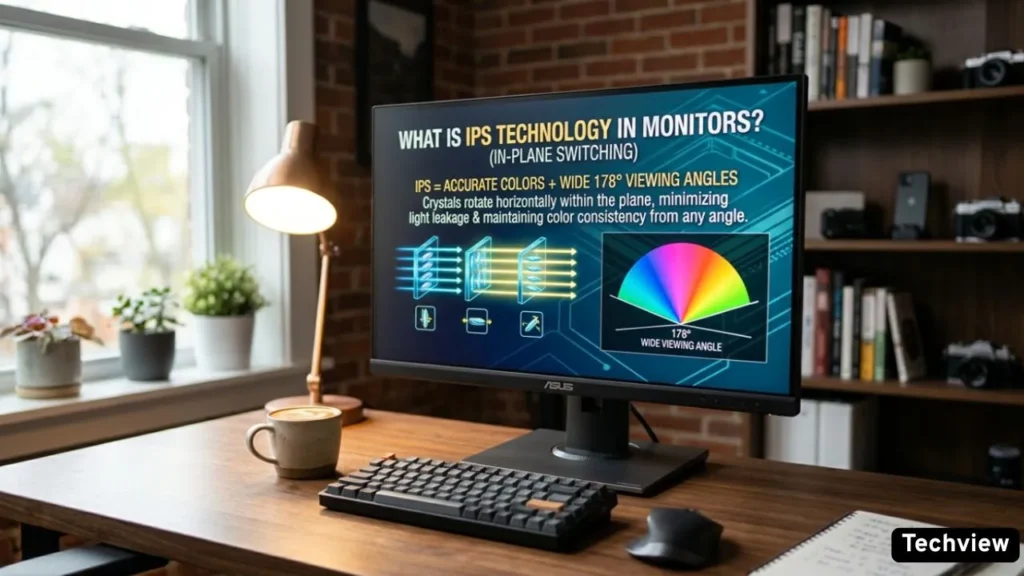
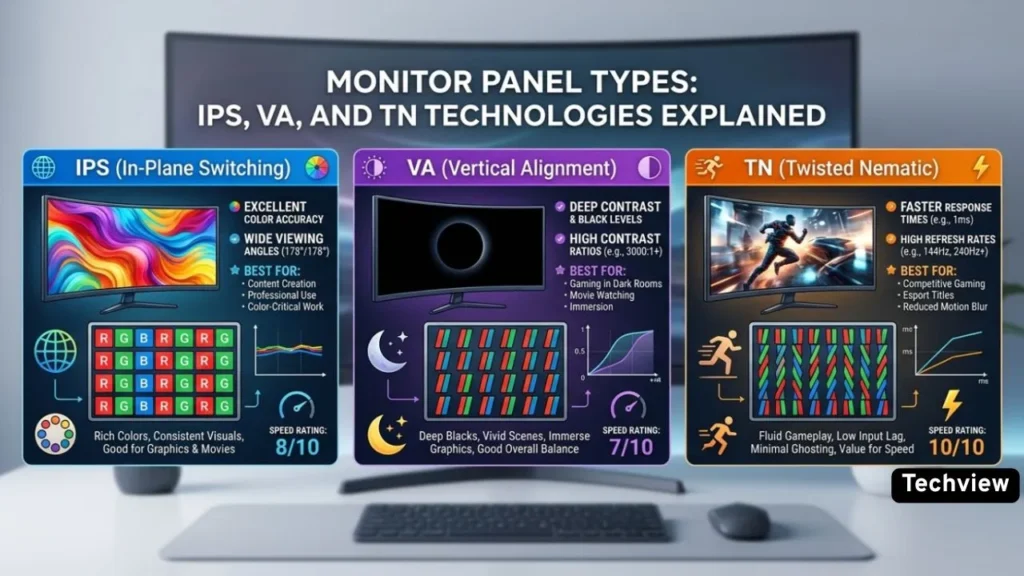
When you go shopping for a new monitor, the monitor panel types are one of the most important things to look at. Yet most people ignore it completely and just focus on screen size or price. That is a mistake. The panel type decides how your colours look, how fast the screen responds, how wide you can view it from, and how deep the blacks appear on screen. The panel type decides how your colors look, how fast the screen responds, how wide you can view it from, and how deep the blacks appear on screen. Choosing the wrong one is a mistake. So before spending your money, take a few minutes to understand what each panel type actually offers. There are four main ones you will come across — TN, VA, IPS, and OLED. Each has a different purpose, a different price range, and a different set of strengths and weaknesses. Let’s go through all of them. 1. TN (Twisted Nematic) Panels TN is the oldest panel type still being sold today. It uses LCD technology that bends to allow light through, and because of its simple design, TN panels are cheaper to make and often the first to see progress as faster refresh rates become available. The one area where TN panels still lead is raw speed. TN panels achieve response times as low as 0.5ms — faster than any IPS or VA equivalent — and support refresh rates of 360Hz and beyond. This is why competitive esports players have always preferred TN. In games where every millisecond counts, this speed gives a real advantage. But the speed comes with clear trade-offs. TN panels have the highest refresh rates and fastest response times, but have inferior image quality and viewing angles. Colors on TN screens look washed out, especially when you move even slightly to the side. If you are sitting dead-center, things look decent. But the moment you tilt the screen or sit at an angle, the image quality drops noticeably. In 2026, TN’s dominance in competitive gaming has eroded significantly. Fast IPS technology has closed the response time gap to under 1ms, making TN’s speed advantage much narrower than it once was. Best for: Budget builds, competitive esports gaming, office setups where color accuracy does not matter. Not ideal for: Photo editing, design work, movie watching, or anything that requires good color. 2. VA (Vertical Alignment) Panels VA panels sit right in the middle of the pack. They are not as fast as TN and not as color-accurate as IPS, but they bring something both of those panels lack — excellent contrast. VA panels routinely hit contrast ratios of 3,000:1 to 6,000:1 — producing visibly deeper blacks and richer shadow detail. For comparison, TN and IPS panels typically sit around 1,000:1. That is a massive difference, and you will notice it immediately when watching movies or playing atmospheric single-player games where dark scenes matter. VA panels feature the highest contrast ratio of the three basic backlit panel types, only beaten by the near-infinite range on OLEDs. These deep blacks help with HDR content, making VA the most popular choice for LED TVs. The main weakness of VA panels is their response time in certain transitions. VA comes with slower black-to-white pixel transitions despite a similar 5ms grey-to-grey response as other models. This can cause a smearing or ghosting effect in fast-moving scenes, which makes VA a less ideal choice for competitive gaming. Viewing angles on VA are better than TN but not as wide as IPS. Thanks to their high contrast and lack of IPS glow, VA panel displays are particularly great for watching movies in a dark room where details in the shadows really stand out, which is why most LED TVs use VA panels, not IPS. Best for: Movie watching, single-player games, general everyday use, people who want deep blacks without paying OLED prices. Not ideal for: Competitive fast-paced gaming or professional color work. 3. IPS (In-Plane Switching) Panels IPS is the most popular panel type for a reason. It hits a solid balance between color performance, viewing angles, and speed — making it a reliable choice for almost anyone. In-plane switching monitors have garnered a lot of acclaim for their color performance. They’re the only variety that regularly provides 95% or even 100% of DCI-P3, the widest color gamut currently formalized and the one used in digital cinema. The viewing angle advantage is significant for IPS. IPS nails color accuracy and consistency with viewing angles that are often better than other technologies, providing visibility from as wide as 178 degrees. This is perfect for video calls, co-reviewing documents, and juggling windows across a dual-display desk. IPS is the go-to choice for designers, photographers, and video editors for this exact reason. When you are editing a photo or grading a video, the colors need to look accurate no matter where you are sitting. IPS delivers that reliability. Speed is also no longer a weak point. Fast IPS has taken over the role TN used to own, with modern IPS monitors now hitting response times under 1ms — good enough for gaming too. The two main downsides of IPS are its contrast ratio and a phenomenon called IPS glow. The usual complaint with IPS is IPS glow. In a dark room, black content can look slightly gray or milky near the corners. Contrast is also usually weaker than VA, so movies and dark games do not look as rich. Price is another factor. IPS monitors cost more than TN and VA, though prices have come down significantly in recent years. Best for: Designers, photographers, video editors, office workers, general-purpose users, gamers who value image quality. Not ideal for: People on a tight budget or those who watch a lot of dark content in low-light rooms. 4. OLED Panels OLED is a completely different technology compared to the three above. The main difference with OLEDs is that each pixel emits its own light, allowing for
Monitor Panel Types: Everything You Need to Know Before Buying Read More »
Technology, Blog